April 14, 2026
What Is Ramadan? Meaning, Fasting Rules, and 2027 Dates Explained
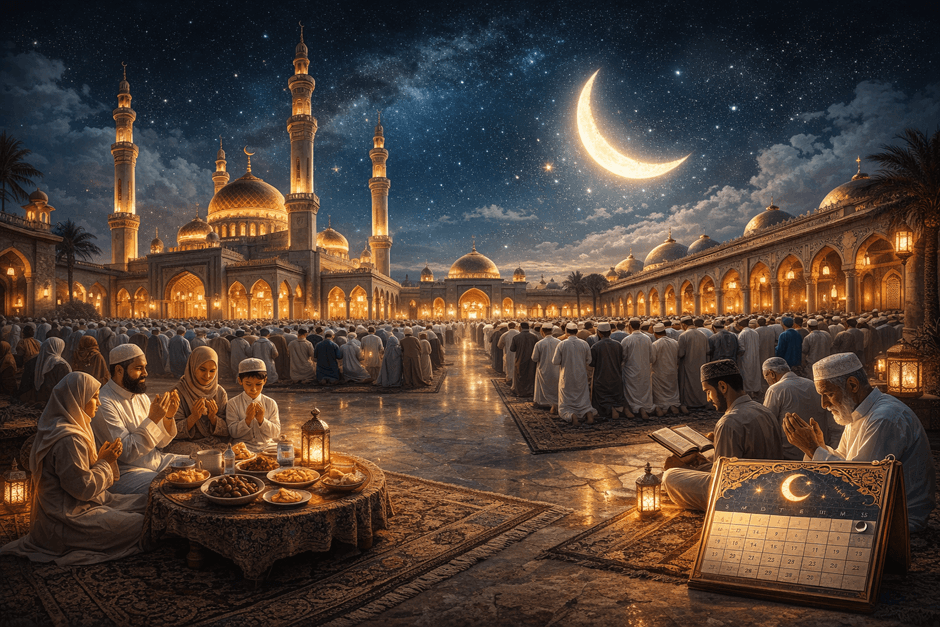
Welcome to the ultimate, comprehensive guide to the holy month of fasting. Whether you are searching for the basic definition of what Ramadan is, want a deep dive into the specific fasting rules, or are a forward planner searching for the exact Ramadan 2027 date, this exhaustive guide has you covered.
What Is Ramadan? - Quick Answer
Ramadan is the 9th month of the Islamic lunar calendar, observed by Muslims worldwide as a sacred time of fasting, prayer, and spiritual reflection. As one of the Five Pillars of Islam, it requires healthy adults to abstain from all food and drink from dawn until sunset to cultivate self-discipline, gratitude, and empathy for those in need.
Ramadan is observed by nearly two billion Muslims around the globe. It is a time of deep spiritual reflection, profound community connection, sincere self-discipline, and heightened charity. For 29 to 30 days, daily life gently adapts to accommodate this beautiful, sacred pillar of Islam.
When Is Ramadan 2027? (Dates & Timings)
Because the Islamic faith operates on a strictly lunar calendar, exact dates shift on the standard Gregorian (Western) calendar every single year. Let’s look at the highly anticipated Ramadan dates for 2027.
You might be wondering how many days are in Ramadan? The Muslim month of Ramadan always lasts exactly one lunar cycle, which means it will either be 29 or 30 days long.
How is this decided? By looking at the night sky. The start of the new Islamic month only officially begins when a designated committee of scholars or astronomers physically sees the tiny sliver of the new crescent moon (called the Hilal) after sunset.
When Does Ramadan 2027 Start?
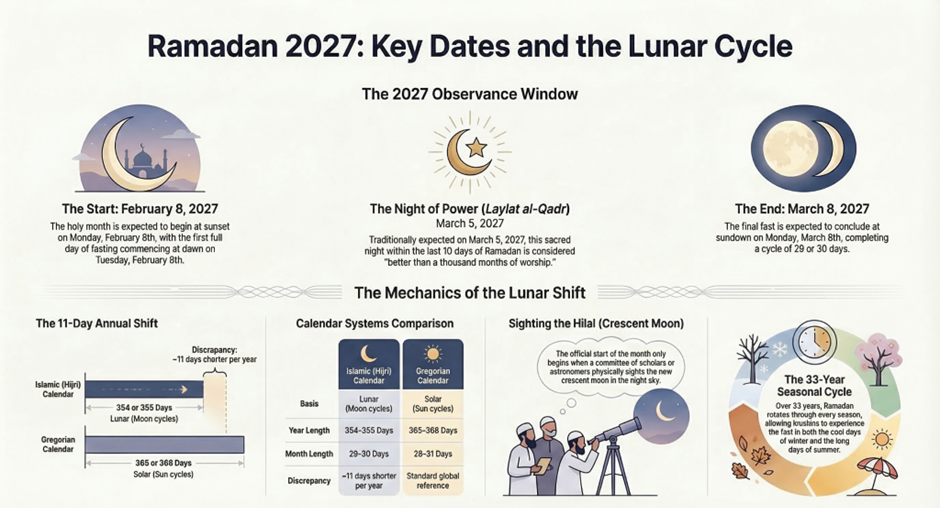
In 2027, the holy month is expected to begin at sunset on Monday, 8 February 2027. Consequently, the first full day of actual fasting will commence at dawn the following morning, on Tuesday, 9 February 2027. If you are planning to travel in this period, you may consider our February Umrah Packages to plan your sacred journey with ease.
When Is the End of Ramadan in 2027?
The final fast of the end of Ramadan is expected to occur on Monday, 8 March 2027, as the sun goes down. This will conclude either 29 or 30 complete days of fasting, ushering in the celebratory festival the following morning. For those wishing to perform Umrah during the final blessed days of the month, our March Umrah Packages are designed to help pilgrims make the most of this spiritually elevated time.
Important 2027 Events: Laylat al-Qadr
The holiest night of the entire Islamic calendar occurs within the last 10 days of this holy month. Known as Laylat al-Qadr (The Night of Power or Decree), this night is better than a thousand months of worship. In 2027, this incredibly sacred night is traditionally expected to fall on or around Friday, 5 March 2027 (the 27th night of the Islamic month).
Why Does Ramadan Change Every Year?
A highly searched question is, "Why does Ramadan change every year?" The Islamic lunar calendar consists of 12 lunar months and has approximately 354 or 355 days in total. The Gregorian calendar (which most of the world uses) has 365 days based on the solar year.
Because the lunar calendar is about 10 to 11 days shorter, the start of Ramadan "moves backward" through the Western calendar by roughly 11 days each year. This is a beautiful feature of the Islamic faith! It ensures that Muslims do not fast in the same season for their entire lives. Over a 33-year cycle, a Muslim will experience fasting during Ramadan in the short, cool days of winter, as well as the long, sweltering days of summer.
Daily Fasting Hours During Ramadan
Fasting takes place from first light (dawn) until sunset every single day of the month. Depending on the time of year and your geographic location, a single day of fasting can last anywhere from 11 to 20 hours!
Why Is Ramadan Important? (Meaning & Significance)
To truly grasp this event, we must look into Islamic theology and history.
The 9th Month of the Islamic Calendar
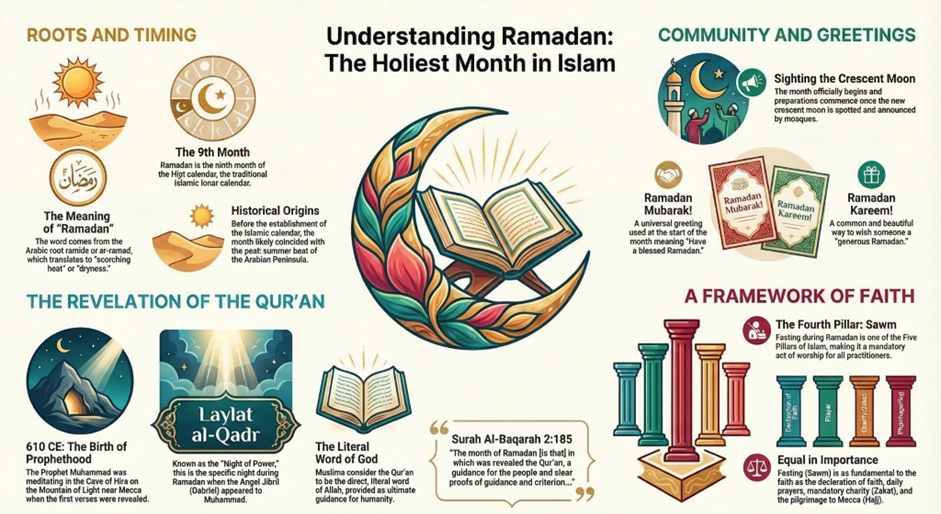
First and foremost, what does Ramadan mean? The word comes from the Arabic root ramida or ar-ramad, which translates to "scorching heat" or "dryness." Historically, before the Islamic calendar was established, this month likely fell during the intense summer heat of the Arabian Peninsula. Today, however, Ramadan the month, simply refers to the 9th month of the Hijri (Islamic lunar) calendar.
The Holiest Month and the Revelation of the Qur'an
According to historical texts and Britannica sources, Ramadan holds unparalleled significance in the Islamic religion because it marks the birth of the Prophet Muhammad's prophethood.
In the year 610 CE, Muhammad was meditating in a cave called Hira, located on the Mountain of Light near Mecca. It was during this month, on Laylat al-Qadr, that the Angel Jibril (Gabriel) appeared to him and revealed the very first verses of the Qur'an.
Muslims consider the Qur'an to be the direct, literal word of God (Allah). Therefore, this 30-day period is not just a fast; it is an extended anniversary celebration of the exact moment God gave humanity its ultimate guidance for humanity.
The Five Pillars of Islam
Fasting during Ramadan (known as Sawm) is not simply a recommended act of worship - it is one of the Five Pillars of Islam, making it a fundamental obligation for every eligible Muslim. Alongside the declaration of faith, daily prayers, charity (Zakat), and the pilgrimage to Makkah (Hajj), fasting holds a central place in a Muslim’s spiritual life.
This is why Ramadan is observed with such deep devotion, as it represents a sacred duty that strengthens faith, discipline, and connection with Allah. For those exploring deeper acts of worship, understanding the difference between Hajj and Umrah can further enrich your spiritual journey.
What Are the Ramadan Rules? (Your Fasting Guide)
What Is Fasting During Ramadan?
When non-Muslims hear the term "fast," they often associate it with modern diets like intermittent fasting. However, what is fasting during Ramadan is much more profound.
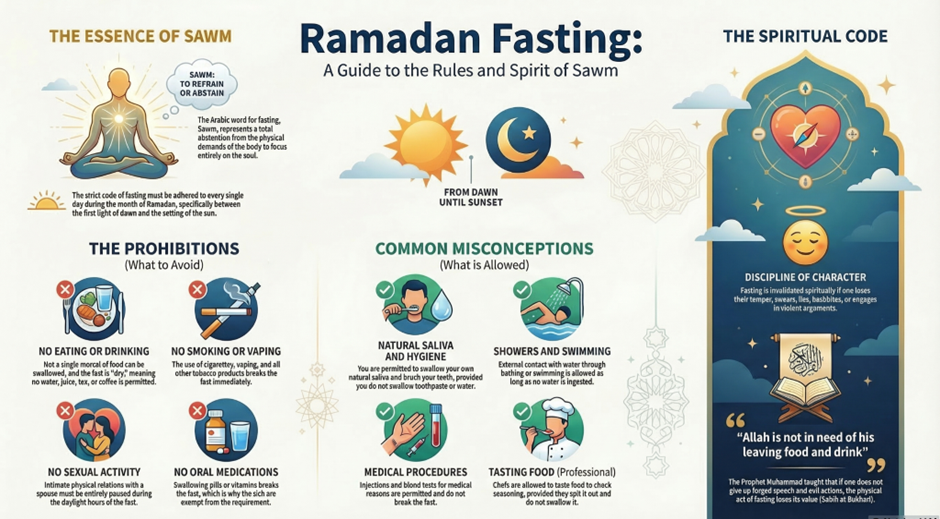
The Arabic word for fasting is Sawm, which literally means "to refrain" or "to abstain." During this time, the goal is total abstention from the physical demands of the body to focus entirely on the soul.
What Can't You Do During Ramadan? (The Rules)
If you are wondering what are the Ramadan rules, they are very strict but incredibly rewarding. Every single day during the month, from the break of dawn until the setting of the sun, healthy adult Muslims must adhere to a strict code.
Here is a list of what you can't do during Ramadan while the sun is up:
- No Eating: Not a single morsel of food can be swallowed.
- No Drinking: This is a dry fast. You cannot consume juice, tea, coffee, and crucially, you cannot drink water while fasting.
- No Smoking: Cigarettes, vaping, and all other tobacco products break the fast immediately.
- No Sexual Activity: Intimate physical relations with a spouse must be entirely paused from dawn until sunset.
- No Medicine (in certain forms): Oral medications and vitamins break the fast (which is why the sick are exempt).
- No Bad Behavior: You cannot lose your temper, swear, lie, backbite, or engage in violent arguments. While these actions might not biologically break the physical fast, the Prophet Muhammad taught that they destroy the spiritual reward of the fast.
What Does NOT Break the Fast? (Common Misconceptions)
Sometimes people misunderstand what is Ramadan rules. Let's clear up a few things you are allowed to do while fasting:
- You can swallow your own natural saliva.
- You can brush your teeth (just don't swallow the toothpaste or water!).
- You can take a shower or go swimming (as long as water isn't ingested).
- You can get injections or blood tests for medical reasons.
- You can taste food if you are a chef, as long as you spit it out and do not swallow it.
Who is exempt from fasting?
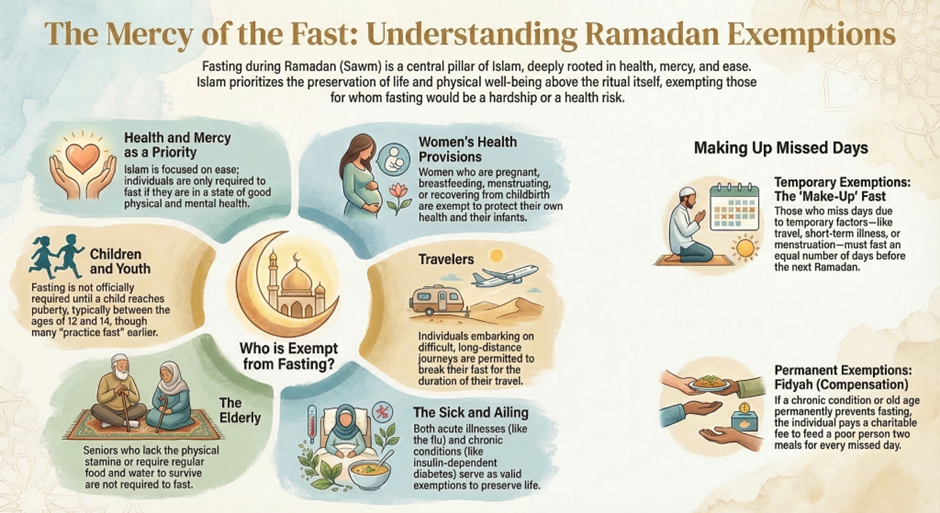
Islam is heavily focused on health, mercy, and ease. You must be in a state of good physical and mental health to perform Sawm. Therefore, millions of people globally are not permitted or required to fast.
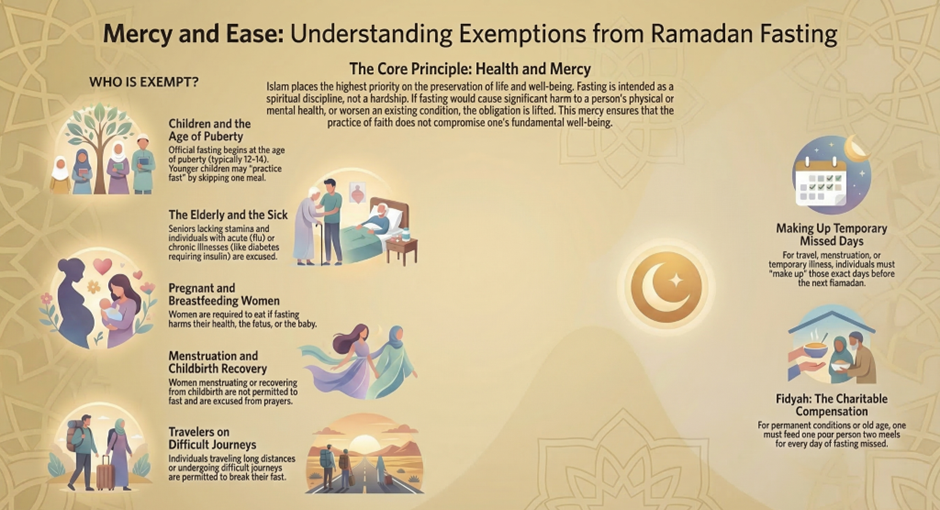
- Children: Kids do not start officially fasting until they reach the age of puberty (usually between 12 to 14 years old). However, younger children will often "practice fast" by missing one meal to join the fun.
- The Elderly: Seniors who lack the physical stamina or require regular sustenance to survive do not fast.
- The Sick: If you have an acute illness (like the flu) or a chronic illness (like severe diabetes requiring daytime insulin), you are excused. In Islam, your health and preserving your life is the ultimate priority.
- Women Who Are Pregnant or Breastfeeding: If a woman feels fasting will harm her health or the health of her developing baby or infant, she must eat.
- Women on Their Period: Women who are menstruating or recovering from childbirth are not permitted to fast and are excused from prayer.
- Travelers: Individuals on difficult journeys spanning long distances are allowed to eat.
What Happens If You Cannot fast?
If a person misses a few days of fasting due to a temporary illness, travel, or menstruation, they must "make up" those exact missed days by fasting before the next Ramadan arrives.
If someone has a chronic medical condition or old age that permanently prevents them from fasting, they pay a charitable compensation known as Fidyah. This requires them to feed a poor person two meals for every day of fasting they missed.
Why Do Muslims Fast During Ramadan?
While fasting can be physically challenging, its true purpose lies in spiritual growth and self-discipline. So, exactly why do Muslims fast in Ramadan?
The Ultimate Goal: Developing Taqwa
In Islam, the primary objective of this rigorous schedule is to develop Taqwa - an Arabic term meaning God-consciousness, mindfulness, or piety. By successfully restraining the natural urges of survival (hunger, thirst, intimacy) simply because God commanded it, a person learns they have immense power over their mind and body.
If you can stop yourself from eating a piece of bread, you can definitely train yourself to stop gossiping, getting angry, or behaving unethically for the rest of the year.
Heightened Empathy and Charity
Imagine looking forward to sunset so you can finally eat, only to remember that millions of impoverished people around the world never get to experience an Iftar feast. They are simply starving every day.
Fasting creates radical empathy. It bridges the gap between the rich and the poor, making the wealthy physically experience the sting of deprivation. Because of this, this month is widely regarded as the month of supreme generosity. In fact, many Muslims calculate and distribute their Zakat (the obligatory 2.5% wealth tax given to charity) exclusively during these 30 days to maximize their heavenly rewards.
Increased Devotional Worship
The focus of this month is completely turning away from the distraction of the physical world (social media, entertainment, food) to read scripture. Millions of Muslims use these four weeks to read the Qur'an from start to finish.
Additionally, after the nighttime Iftar meal is complete, mosques fill to the brim with worshippers gathering to perform Taraweeh. These are special, extended congregational night prayers held exclusively during this time, where long passages of the holy book are recited out loud until midnight.
Daily Life During Ramadan (Suhoor, Iftar & Routine)
During the holy month, daily routines gently adapt to accommodate fasting, prayer, and night-time worship. Since you cannot consume anything during the daytime, all culinary and social gatherings happen in the pitch-black night.
Suhoor: The Pre-Dawn Meal
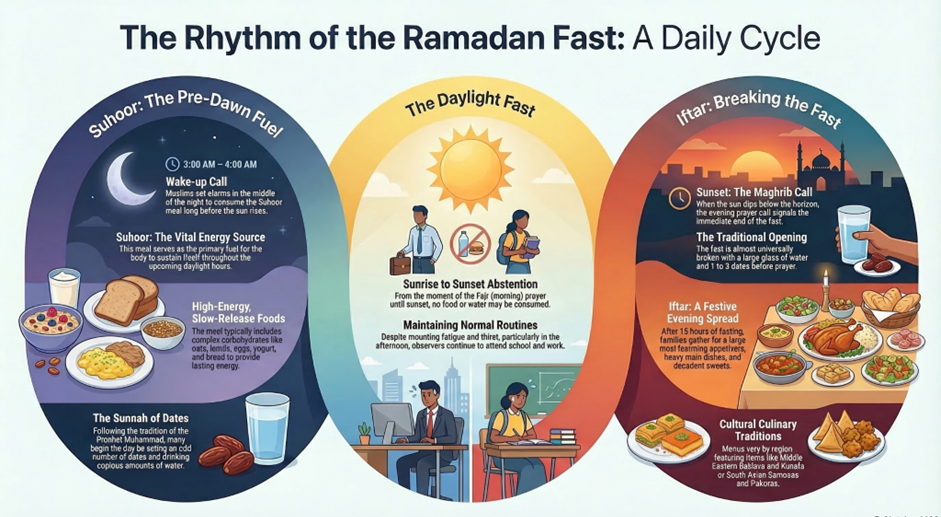
When can you eat in Ramadan? It begins long before the sun rises. Muslims will set their alarms for the middle of the night (sometimes 3:00 AM or 4:00 AM depending on the season) to wake up and eat the Suhoor meal.
This is the fuel for the day. Suhoor usually consists of high-energy, slow-releasing complex carbohydrates: oats, eggs, lentil soup, yogurt, breads, and copious amounts of water. Traditionally, Muslims follow the habit (Sunnah) of the Prophet Muhammad by eating odd numbers of dates to start their day. At the moment dawn approaches, eating stops, and the morning Fajr prayer is performed.
Iftar: Breaking the Fast at Sunset
The fast lasts all day. During the afternoon, Muslims continue to work, go to school, and manage normal life, though fatigue and thirst certainly set in.
Finally, as the sun dips below the horizon, the call to the evening prayer (Maghrib) echoes out. This signals the start of the night and the time for Iftar, the meal to break the fast.
Almost universally, Muslims celebrate the breaking of their daily fast by consuming 1 to 3 dates and a large glass of water. After performing their prayers, they sit down for the main Iftar meal. Because you haven't eaten for perhaps 15 hours, Iftar is often a warm and nourishing meal shared with family and community featuring a mixture of appetizers, heavy main dishes, and decadent traditional sweets (like Baklava or Kunafa in Middle Eastern cultures, or Samosas and Pakoras in South Asian households).
Ramadan Greetings: How to Wish Someone in Ramadan
As the blessed month of Ramadan begins with the sighting of the crescent moon, Muslims around the world welcome it with joy, gratitude, and heartfelt prayers. It is a time when communities come together, and sharing warm greetings becomes a beautiful way to spread positivity and unity.
If you are wondering how to wish someone at the start of Ramadan, there are two widely used and meaningful greetings:
- "Ramadan Mubarak" – meaning "Have a blessed Ramadan"
- "Ramadan Kareem" – meaning "Have a generous Ramadan"
These greetings reflect the spirit of the holy month - kindness, generosity, and spiritual reflection. Whether you are greeting family, friends, colleagues, or neighbors, these simple words help strengthen bonds and express good wishes for a peaceful and spiritually rewarding Ramadan.
What Is the End of Ramadan Called? (Eid al-Fitr Explained)
Fasting forever is impossible, and after 29 or 30 days of grueling discipline, the arrival of the new crescent moon brings the trial to a close.
What is Ramadan Eid?
If you search for "what is the end of Ramadan called?" or "what is Ramadan Eid," the answer is Eid al-Fitr (pronounced eed-al-fitter).
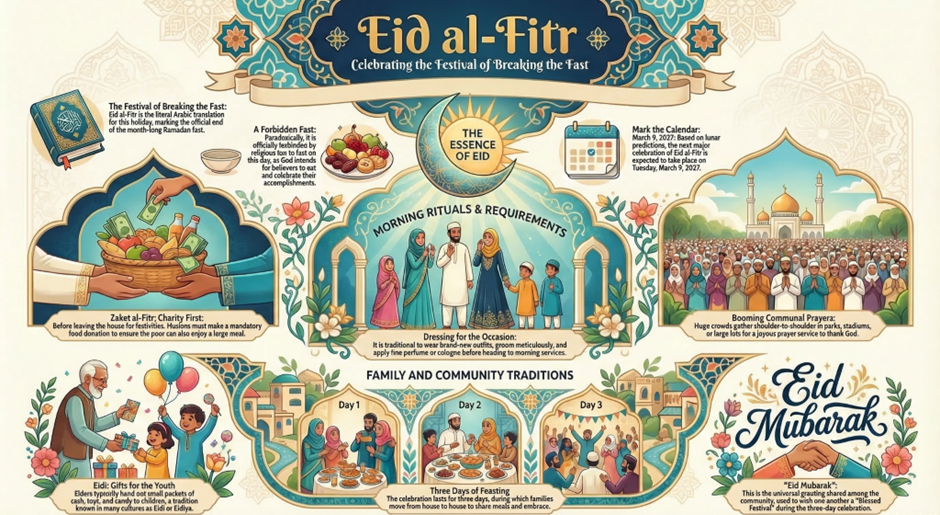
Eid al-Fitr literally translates from Arabic as the "Festival of the Breaking of the Fast." It is one of the two most important canonical religious holidays in Islam (the other being Eid al-Adha). For the dates for Ramadan 2027, Eid al-Fitr is predicted to take place on Tuesday, 9 March 2027.
How Do Muslims Celebrate Eid al-Fitr?
You cannot understand what are the rules of Islam without knowing this surprising fact: It is officially forbidden to fast on Eid al-Fitr! God wants His believers to eat, be happy, and celebrate their accomplishments.
Here is what the day of Eid al-Fitr typically involves:
- Zakat al-Fitr: Before anyone leaves their house, they must donate a mandatory charitable payment specifically for food. This ensures that every poor person in the world has a large meal on Eid day and doesn't have to beg or starve.
- Special Eid Prayers: In the early morning, large gatherings of worshippers come together in prayer.
- New Clothes and Perfume: It is traditional to buy brand-new outfits, groom beautifully, and wear perfume/cologne to the morning prayers.
- Gifts for Children: In many cultures, elders hand out small packets of cash (known as Eidi or Eidiya) to excited kids, alongside toys and candy.
- Visiting the Community: Families spend the next three days moving from house to house, embracing, declaring "Eid Mubarak," and feasting on daytime spreads.
Quick Ramadan Facts for Beginners
Sometimes it's easier to digest information quickly! Whether you're a teacher building a curriculum or a parent explaining this faith, Here are some insightful and easy-to-understand facts to deepen your understanding of this blessed month.
5 Quick "Did You Know" Ramadan Facts
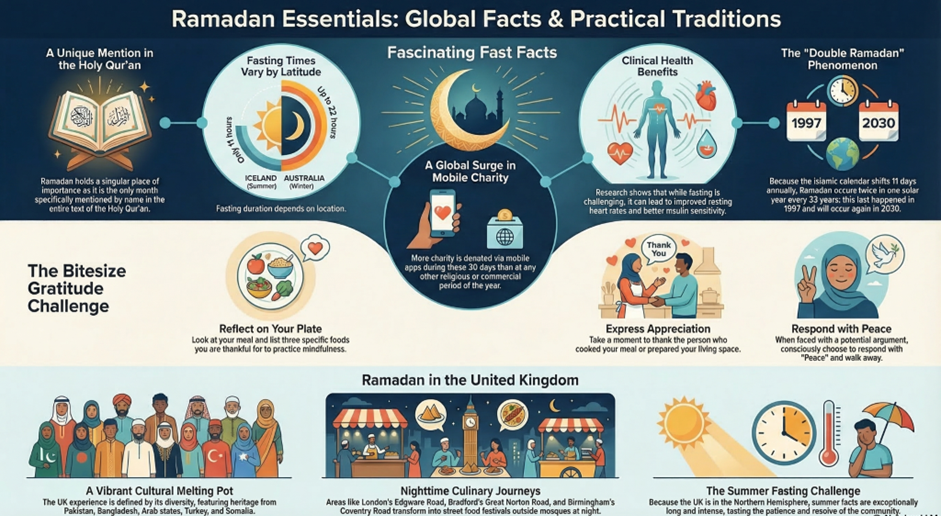
- It is the only month mentioned specifically by name in the entire text of the Holy Qur'an.
- Ramadan fasting time varies drastically depending on where you live. For example, Muslims living in Iceland or Norway during a summer fasting cycle might fast for up to 21 or 22 hours, whereas someone in Australia during their winter might only fast for 11 hours!
- More charity is given via mobile apps during this 30-day window globally than at any other religious or commercial period of the year.
- Research indicates that fasting during Ramadan, while tough on the first few days, has shown clinical health benefits regarding resting heart rate and insulin sensitivity.
- Since the Islamic calendar rotates 11 days backward against the Western solar year, about twice a century, the 30-day period will happen twice in the same solar year! This last happened in 1997 and will happen next in 2030 (January 2030 and December 2030).
Activity: Simple Ramadan Activities for Beginners:
Fasting isn't just about avoiding food; it's a focus on positivity. Here are a few simple ways to reflect the spirit of Ramadan in your daily life:
- Look at a meal you are eating and list three specific foods on your plate you are thankful for.
- Thank someone who cooked a meal or prepared a space for you.
- Instead of arguing with a sibling or colleague today, choose to respond with "Peace" and walk away!
Ramadan in the UK: Dates, Fasting Hours & Community Life
Ramadan in the United Kingdom is a uniquely vibrant experience marked by a deep sense of community and spiritual devotion. The UK boasts a large and diverse Muslim community with heritage spanning from Pakistan and Bangladesh to the Arab states, Turkey, and Somalia. This diversity makes the holy month a truly multicultural event across the country.
Vibrant Community and Culinary Hubs
When the sun sets, local Halal areas transform into bustling centers of activity. Exploring famous spots like London's Edgware Road, Bradford’s Great Horton Road, or Birmingham’s Coventry Road during nighttime hours becomes a rich and culturally diverse Iftar experience. Huge nighttime street food festivals often pop up right outside local mosques, offering a variety of traditional foods for Iftar.
Fasting Hours in the Northern Hemisphere
Because the UK is located in the Northern Hemisphere, fasting hours can vary drastically depending on the season. During summer cycles, fasts are intensely demanding, sometimes lasting 18 to 19 hours, testing the patience and resolve of British Muslims. Conversely, winter fasts are much shorter. Regardless of the time of year, the spirit of charity and resilience remains a cornerstone of the UK Ramadan scene.
Whether you are attending a community Iftar or looking for local prayer timings, the experience of Ramadan in the UK is one of immense generosity and connection.
Key Takeaways About Ramadan
- Definition: Ramadan is the 9th and holiest month of the Islamic lunar calendar, marking the period when the Qur'an was first revealed to the Prophet Muhammad.
- The 2027 Dates: Ramadan 2027 is expected to begin at sunset on Monday, 8 February, with the final fast occurring on Monday, 8 March.
- The Fasting Rules (Sawm): Healthy adult Muslims abstain from all food, liquids (including water), smoking, and physical intimacy from dawn (Suhoor) until sunset (Iftar).
- Who is Exempt: Children, the elderly, the sick, travelers, and women who are pregnant, breastfeeding, or menstruating are not required to fast.
- The Spiritual Purpose: The primary goal of fasting is to achieve Taqwa (God-consciousness), practice self-discipline, and develop empathy for the impoverished through increased charity (Zakat).
- The Conclusion: The month of fasting ends with Eid al-Fitr, a three-day celebration of joy, community prayer, and feasting.
Frequently Asked Questions About Ramadan
Do you still have lingering queries about the definition of Ramadan, how long it is, or how it works? Let's dive into some rapid-fire answers targeting the most highly searched questions from Google!
Final Thoughts on Ramadan
Taking the time to research "what is Ramadan about" means you are a culturally sensitive and intellectually curious human being! This awe-inspiring event bridges cultural gaps, repairs broken spirits, feeds millions of poverty-stricken people worldwide, and connects believers to their Creator through intense humility.
Many Muslims across the UK also choose this sacred month to perform Umrah - a deeply personal act of worship that beautifully complements the spirit of Ramadan. If you are considering this spiritual journey, our Umrah packages are tailored to help UK pilgrims travel with ease and devotion.
We hope this ultimate guide properly explains the facts, significance, timing, and unbending beauty behind Islam's most highly anticipated time of year. So, as we look to the beautiful winter of 2027, or whatever year you find yourself reading this, Ramadan Mubarak!
Planning your Pilgrimage?
Al Habib Travel specializes in creating meaningful experiences. Let us handle your visa and accommodation.